Service Offerings

Explore tailored services designed to solve business challenges and support growth

Industries

Discover industry-focused expertise built to meet unique business needs

Partners

Meet our service partners who strengthen delivery and support client success

Learn how to modernize data foundations to enable trusted, scalable AI.

Global supply chain leader in apparel embarks on unified analytics strategy with Microsoft Fabric

See how a unified data strategy built faster insights and scaled analytics.

Microsoft solutions partner for Data & AI

Products

Explore our digital products built to streamline work and drive growth every day

Partners

Meet our product partners who enhance our solutions and expand client value

AI-powered automated
 regression testing: Your
kickstart for 2026

Explore a better way to speed up testing and improve release quality.

Resources

Access blogs, case studies, events, and insights that support smarter decisions.

Latest Resources

CASE STUDY

HamiltonJet transforms regression testing on Infor CloudSuite with Fortest

NEWS

Fortude earns Microsoft Azure Infrastructure Solutions designation

Our People

Discover a culture where you can grow and shape what’s next

Everyone can grow at Fortude

We believe in creating a global workplace where everyone can grow. This is amplified by our teams, who say the best thing about Fortude is our culture, one that is brought to life by a diverse team that spans across continents.

Latest

Fortude builds momentum for women in tech with all-female Ignite 2.0 tech internship

Aug 22, 2025

Pioneering innovation and inculcating learning in the age of AI

Aug 01, 2024

About us

Learn who we are, what we do, and the values that drive our growth

News & events

Stay updated with Fortude news, events, stories, and company highlights.

Contact us

Get in touch with our team to ask questions or start a conversation

Your nearest office- Sri Lanka

Fortude (Pvt) Ltd
146 Kynsey Road, Colombo 7, Sri Lanka

Email – talk-to-us@fortude.co
Phone – +94 11 453 1531

What defines us goes beyond what we do

Every day, we bring together diverse perspectives, strong leadership and responsible thinking to build a business that creates lasting value for our clients, people and communities.

Fortude secures major Solutions Partner achievement with Analytics on Microsoft Azure Specialization

Office locations

Data & AI

Six reasons to embrace food supply chain transparency

6 MIN READ

May 31, 2021

Share

Introduction

Transparency is a key goal of any business enterprise that relies on a complex supply chain. For organizations in the food and beverage industry, these goals have critical implications. In this blog post, we explore the reasons why enterprises should embrace supply chain transparency with a special focus on the food and beverage industry.

What is supply chain transparency?

The terms “transparency” and “visibility” are often used interchangeably, and their definitions differ across industries and organizations. Though often used interchangeably, visibility has a slightly different connotation. Traceability is a closely related concept.

Transparency

Transparency is making all information regarding the products and processes available to all stakeholders: consumers, partners, shareholders, and regulatory bodies.

Visibility

Visibility allows stakeholders to closely examine a product or a process at a particular link or a touchpoint in the supply chain. stakeholders: consumers, partners, shareholders, and regulatory bodies.

Traceability

Supply chain traceability is the ability to track the origin and journey of products, from sourcing and manufacturing to consumption, the end of the supply chain.

Meet consumer demand for transparent food supply chains

Today’s consumers are conscientious. They are motivated by health, wellbeing, and social issues and consider nutrition information, actual benefits, visibility into suppliers, treatment of animals, and environmental sustainability — and these motivations affect their buying decisions.

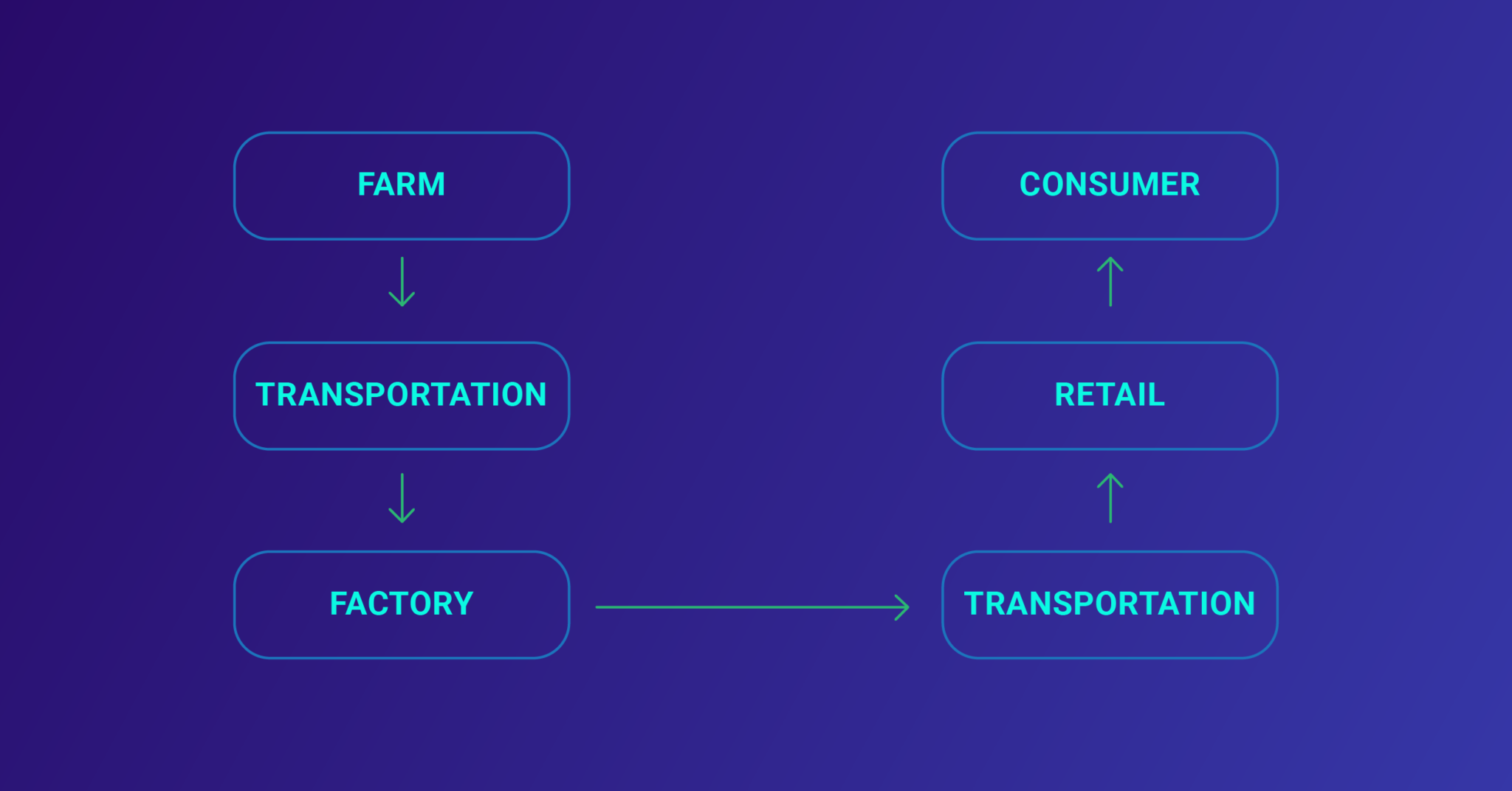
A culmination of this new thinking behavior is the farm-to-table social movement, which expects organically grown, fresh, local produce. These expectations put a lot of pressure on food and beverage companies. If a company fails to satisfy these needs, consumers have multiple alternatives to choose from: the competition is high.

Figure 1: Farm to table process

Transparency is extremely important or important to 81% of shoppers both online and at brick-and-mortar stores, according to Transparency Trends: Omnichannel Grocery Shopping from the Consumer Perspective, a report published by FMI and Label Insights, a product transparency market leader.

Supply chain transparency is an important differentiator, especially for food and beverage manufacturers and retailers. It helps build brand loyalty and trust.

Identifying and responding to food safety issues

From salmonella contamination in poultry to undeclared peanuts in granola bars, food and beverage safety issues can lead to serious health risks for the public. If you visit the web spaces of regulatory bodies such as the U.S. Food and Drug Administration, Rapid Alert System for Food and Feed (EU), and Food Standards Australia New Zealand, you can see a list of recalls for each region.

According to WHO, 351,000 people die of foodborne diseases globally—every year.
Even more people are hospitalized, and millions of people get sick.

As news of food recalls go viral, they jeopardize the years of trust and brand value food and beverage companies have built with partners and consumers. There is also pressure from regulatory bodies. For example, the United States’ Food Safety Modernization Act (FSMA) expects food & beverage companies to be proactive in preventing food safety issues.

Having a transparent and visible supply chain enables F&B companies to respond to food safety issues and recalls swiftly. With traceability, companies can trace problematic batches, lots, and shipments throughout the supply chain and take necessary actions to contain them.

Cutting down food waste and loss

The United Nations’ Food and Agriculture Organization (FAO) estimates the global volume of food wastage to be about 1.3 billion tons per year, which amounts to one-third of food produced for human consumption. This happens in a backdrop where nearly 870 million people are undernourished globally.

Food waste and loss can happen at any stage of the farm-to-table process.

On the farm

  • Low produce due to weather and climate fluctuations.1
  • Availability, quality, and nutritional aspects vary due to the seasonal nature.

In the factory

  • Poor handling
  • Lack of knowledge and training
  • Obsolete processes and equipment.

Transportation

  • Spoilage caused by delays
  • Improper temperature control during transportation
  • Improper storage during transportation

In the warehouse

  • Pest infestations
  • Improper temperature and humidity levels
  • Poor planning leading to prolonged storage of products with a limited shelf life

In the store

  • Limited shelf life
  • Not meeting the freshness, color, flavor, and texture expectations

At the table2

  • Expiry
  • Overbuying

1 Global climate change threatens up to 25% of crop yields – report by World Economic Forum and McKinsey & Company

2 Average U.S. household wasted 31.9% of its food – American Journal of Agricultural Economics

The ability to easily track the source and usage of raw materials, ingredients, and finished food batches across all the above stages is key to understand how, when, and where food loss and waste happens in the food supply chain.

On the farm
In the factory
Low produce due to weather and climate fluctuations. Availability, quality, and nutritional aspects vary due to the seasonal nature.
Poor handling Lack of knowledge and training Obsolete processes and equipment.

FAQ

Meeting compliance and regulatory requirements

Public health is a high priority for governments and policymakers. Newer regulations require agile responses to food recalls and the manufacturer’s ability to trace products quickly. For example, under the Food Safety Modernization Act of 2011, the US FDA will have the authority to require traceability for selected high-risk food items. Australia’s National Livestock Identification System (NLIS) mandates the identification and traceability of cattle, sheep, and goats throughout their lifespan. European Food Safety Authority has laid down similar measures.

Also, regulations change often; having supply chain transparency and traceability enables manufacturers to adapt to new regulations and provide the information required for doing business with new markets, quickly.

FAQ

Sustainability beyond the farm

While sustainable and environment-friendly farming practices play a critical role, sustainability matters beyond the farm, throughout the food supply chain.

The sustainability goals in the food supply chain are under challenge due to the growing world population and resource scarcity. Adding to the woe, if ecosystems continue to degrade at the current rate, we will soon reach a point of no return.

On the farm, food manufacturers practice crop rotation to preserve soil health and to prevent soil erosion. Methane, a greenhouse gas emitted by dairy cows, affects the earth’s temperature and climate stability. A 2015 study showed that adding seaweed to cattle feed can significantly cut down methane emissions. Similarly, many novel technologies have been implemented to improve sustainability during transportation, warehousing, and retail.

For F&B companies, sustainability is no longer a trend but a business imperative for better profitability, long-term viability, and, most importantly, to safeguard the wellbeing of consumers. And to identify, plan, implement and optimize sustainable practices throughout the food supply chain, transparency and visibility play a key role.

In the next blog post, let’s explore how enterprises can use the cloud, business intelligence, analytics, and Industry 4.0 technologies to improve visibility, transparency, and traceability across the food supply chain.

References:

  1. Estimating Food Waste as Household Production Inefficiency, American Journal of Agricultural Economics
  2. Best Practice Guide: Improving supply chain transparency in modern food and beverage manufacturing, Infor
  3. Report: Incentivizing Food Systems Transformation, World Economic Forum in collaboration with McKinsey & Company

FAQ

“ Charlie’s agentic capabilities are specifically designed to address the volatility inherent in fashion and retail planning.”

– John Doe

Global supply chain leader in apparel
embarks on unified analytics

In production, AI agents optimize processes for waste reduction and improved sustainability.

CONTENTS

Introduction
What is supply chain transparency?
Meet consumer demand for transparent food supply chains
Identifying and responding to food safety issues
Cutting down food waste and loss
Meeting compliance and regulatory requirements
Sustainability beyond the farm

Receive the latest
Fortude Newsletter
updates.

Share

Receive the latest
Fortude Newsletter
updates.

Share