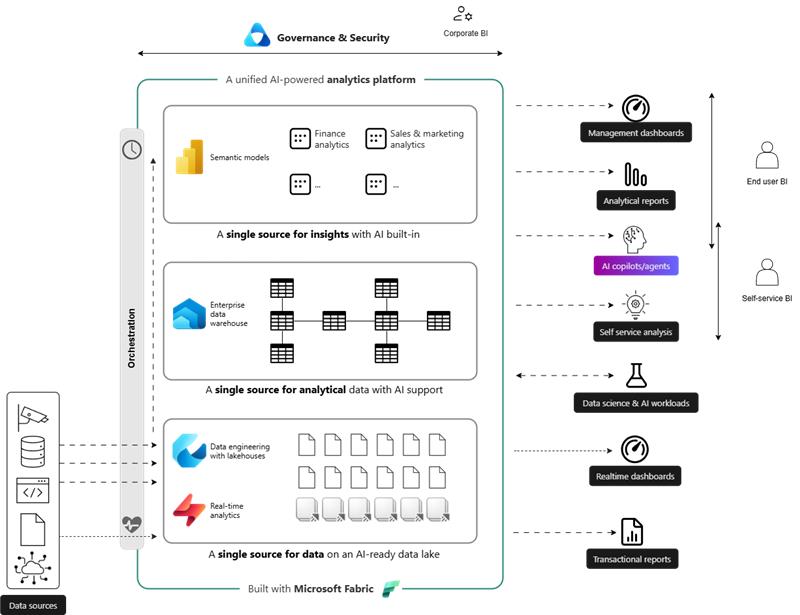
The easiest way to understand your data architecture is to view it like you would your own home. A home without a foundation would not stand, and it is the structured elements or layers of a home that give it a cohesive look.
So, let’s take a look at each of these layers and the roles they play in your data architecture, and in parallel look at how our Lakehouse Accelerator steps in at each of these junctures to give structure and drive efficiency across the layers.
- Layer 1: The lakehouse (single source of data) – If you’re wondering what a lakehouse is, it’s essentially a place that stores all kinds of raw data, structured or unstructured, in one central location. Whether it’s from your enterprise resource planning (ERP) system, customer relationship management (CRM) system, warehouse management systems, or even media, this foundational layer brings all that data together to live in one place.
The role of our accelerator: The Lakehouse accelerator plays an important role at this stage because it fast-tracks the implementation of this foundational layer. The accelerator has pre-built pipelines that bring all this data together to the lakehouse, and more importantly, it can be customized accordingly to suit your own unique requirements and data sources.
- Layer 2: The data warehouse (single source of analytics) – This is where the data from the lakehouse is transformed and merged into analytical data. On top of this data, standard organization-wide business logic is applied. It can be used to model the data so it can be used for different use cases. This allows your teams to analyze metrics across functions, identify trends, and make decisions based on a complete view of the business, rather than piecing together data from multiple places. For example, sales data from your CRM, inventory data from your ERP, and marketing data from your campaigns can all be combined in the warehouse to target products to specific customer segments.
The role of our accelerator: Despite it being called the lakehouse accelerator, our solution also sets up the structure for this layer as well so you have the freedom to customize it quickly based on business needs.
- Layer 3: Semantic models (self-service analytics) – This additional layer allows you to apply a set of function-specific calculations and business logic making it intuitive for non-technical end users to easily understand their data. For instance, the marketing team will be able to drag and drop the metrics of a campaign into a canvas and easily build a report to quickly understand the granularities of performance.
The role of our accelerator: To this layer too, the lakehouse accelerator provides structure on top of which Fortude consultants can come in, talk to you , and build the metrics to suit your requements. In addition, we have pre-built analytics accelerators such as the sales and finance ones to help you easily set up and get started. We will talk about these accelerators in detail in the next blog in this series.