Service Offerings

Explore tailored services designed to solve business challenges and support growth

Industries

Discover industry-focused expertise built to meet unique business needs

Partners

Meet our service partners who strengthen delivery and support client success

Learn how to modernize data foundations to enable trusted, scalable AI.

Global supply chain leader in apparel embarks on unified analytics strategy with Microsoft Fabric

See how a unified data strategy built faster insights and scaled analytics.

Microsoft solutions partner for Data & AI

Products

Explore our digital products built to streamline work and drive growth every day

Partners

Meet our product partners who enhance our solutions and expand client value

AI-powered automated
 regression testing: Your
kickstart for 2026

Explore a better way to speed up testing and improve release quality.

Resources

Access blogs, case studies, events, and insights that support smarter decisions.

Latest Resources

CASE STUDY

HamiltonJet transforms regression testing on Infor CloudSuite with Fortest

NEWS

Fortude earns Microsoft Azure Infrastructure Solutions designation

Our People

Discover a culture where you can grow and shape what’s next

Everyone can grow at Fortude

We believe in creating a global workplace where everyone can grow. This is amplified by our teams, who say the best thing about Fortude is our culture, one that is brought to life by a diverse team that spans across continents.

Latest

Fortude builds momentum for women in tech with all-female Ignite 2.0 tech internship

Aug 22, 2025

Pioneering innovation and inculcating learning in the age of AI

Aug 01, 2024

About us

Learn who we are, what we do, and the values that drive our growth

News & events

Stay updated with Fortude news, events, stories, and company highlights.

Contact us

Get in touch with our team to ask questions or start a conversation

Your nearest office- Sri Lanka

Fortude (Pvt) Ltd
146 Kynsey Road, Colombo 7, Sri Lanka

Email – talk-to-us@fortude.co
Phone – +94 11 453 1531

What defines us goes beyond what we do

Every day, we bring together diverse perspectives, strong leadership and responsible thinking to build a business that creates lasting value for our clients, people and communities.

Fortude secures major Solutions Partner achievement with Analytics on Microsoft Azure Specialization

Office locations

Agentic AI solutions

AI Agents for Workflows: What’s Working, What’s Not

7 MIN READ

December 23, 2025

Share

Introduction

As enterprises seek new ways to automate workflows, AI agents have emerged as one of the hottest topics in tech. But beyond the hype and headline use cases, what’s actually working in the field? And what are the friction points still slowing adoption?

Reddit threads such as r/productivity and r/LangChain are filled with first-hand experiences from early adopters, skeptics, and builders. According to Reddit users, AI agents for workflows are making progress, but there’s still plenty of room for growth. Here’s what we uncovered, and how Fortude’s agents built into Charlie – its AI knowledge assistant are already addressing some of these critical pain points.

The promise of AI agents: Delegation, not just automation

In theory, AI agents represent a step beyond rule-based automation. These agents are designed to act autonomously within defined parameters, reasoning through tasks, making decisions, and even collaborating with other agents or systems. On paper, they promise scalable workflow orchestration and time savings across knowledge work, operations, and support functions.

But as one Reddit user aptly put it:

This sentiment is echoed across dozens of threads, where users report AI agents that shine at narrow, well-defined tasks but struggle with multi-step processes, data context, and reliability.

The aspiration is clear: enterprises want intelligent assistants that go beyond static RPA scripts. But the road to agentic maturity is paved with cautionary tales. The stakes are especially high in mission-critical systems, where even small deviations can cause business disruptions.

What’s working: Narrow tasks, busywork, and retrieval

Despite the skepticism, many Reddit users shared use cases where AI agents are already providing value:

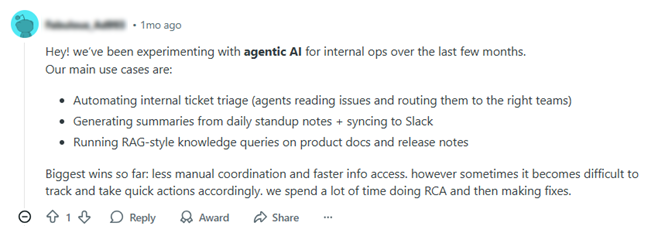
  • Email and task triage: Agents that sort, tag, and prioritize tickets or emails, especially in internal support workflows.
  • RAG-style knowledge lookups: Summarizing product documentation, answering common internal questions, and streamlining information retrieval.
  • Daily summaries and updates: Generating Slack or email digests from meeting notes or project management tools.
  • ERP data pre-fetching and autofill: Automatically populating forms or dashboards based on user queries.

One user noted:

Others highlighted:

  • Document summarization to extract insights from lengthy SOPs or compliance guidelines.
  • HR query bots that surface policies, time-off balances, and onboarding checklists on demand.
  • Agent chaining to automate sequences like lead qualification, CRM update, meeting booking.

These narrow applications reduce time on repetitive tasks and support faster access to structured knowledge, with lower risk.

What’s not working yet: Accuracy, orchestration & observability

The Reddit community was just as vocal about what’s not working:

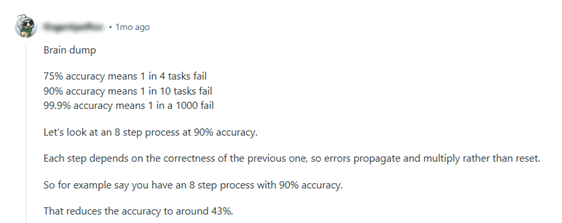
  • Compounding failure rates: As one user shared, a 8-step workflow with 90% accuracy per step results in only 43% success overall. Error propagation remains a major concern.
  • Context drift and hallucination: Agents still struggle to consistently retain context over long tasks or across systems.
  • Lack of observability: Builders warn that without a monitoring layer, it’s impossible to understand why an agent behaved a certain way or where it went off track.
  • Hard-to-scale integrations: Connecting agents to legacy systems, CRMs, or ERPs often requires custom APIs, tools, or middleware.

One user noted:

“The biggest challenge is maintenance: agents need clear rules, monitoring, and fallback protocols, otherwise small errors snowball fast.” -r/LangChain-

Another user mentions:

“Biggest challenges are context management, trust, and integrating with internal systems.” -r/LangChain-

These cautionary notes echo a common refrain: start small, validate often, and monitor everything.

Meet Charlie: Fortude’s answer to practical AI agent challenges

At Fortude, we’re not just following the AI agent conversation, we’re actively shaping it with Charlie, our enterprise-grade AI assistant. Built on a Retrieval-Augmented Generation (RAG) framework, Charlie is evolving from a knowledge assistant into an agentic AI platform with real-world impact.

Unlike general-purpose agents that try to do everything, Charlie is purpose-built for enterprise workflows. Each use case is designed around domain-specific pain points, with built-in safeguards, monitoring, and explainability baked into the design.

Let’s explore how Charlie is solving the pain points that Reddit builders are wrestling with.

1. Inventory levelling agent

Charlie’s inventory management agent uses real-time demand signals to assess stock levels and suggest redistribution between locations. This reduces stockouts and overstock scenarios without human intervention.

  • Why it matters: It’s a tightly scoped, high-value task, exactly what Reddit users suggest agents should start with.

2. M3 release impact analysis

When a new Infor M3 release is published, a set of coordinated agents, including document parsers and source code analyzers, automatically identify impacted modules and generate Jira tickets for consultants.

  • Why it matters: It removes 80–90% of manual analysis effort, while maintaining traceability and confidence through built-in validation layers.

3. Signal-based demand forecasting

This Charlie agent blends internal ERP data with external signals (e.g., weather, trends) to forecast SKU-level demand for fashion retailers. It recommends POs and shipment timelines in a single automated pass.

  • Why it matters: Combines structured planning logic with adaptive context awareness, a step toward trustworthy decision-making.

4. MCP for ERP interoperability

Charlie integrates with Fortude’s Model Context Protocol (MCP), enabling secure and reusable access to Infor ERP systems. It acts as a translator layer, giving AI agents safe access to business data.

  • Why it matters: This solves a massive pain point raised in Reddit threads: messy, inconsistent ERP integrations.

5. CharlieX: Democratizing enterprise intelligence

CharlieX, a companion to Charlie, focuses on enterprise analytics. It connects directly to ERP/CRM data and lets business users ask natural-language questions, surfacing patterns, anomalies, and recommendations in seconds.

  • Why it matters: This bridges the gap between AI and decision-makers, allowing agents to proactively suggest actions instead of just returning results.

FAQ

Best practices from the field: Lessons from Reddit and the enterprise

From hundreds of comments and real-world use cases, a few best practices emerge:

  • Start narrow: Choose one pain point with clear ROI. Avoid broad, loosely scoped workflows.
  • Build feedback loops: Use human-in-the-loop validation, even in production.
  • Prioritize observability: Include logging, tracing, and evaluation from day one.
  • Structure data access: Use protocols like MCP to define safe, scalable interfaces.
  • Accept imperfection: Even a 70% reliable agent can drive ROI if paired with intelligent fallback mechanisms.

FAQ

A realistic outlook: What’s next for AI agents in workflows?

The community sentiment is clear: AI agents are promising, but expectations need calibration. They’re not magic wands or full-time employees. But they can become trusted collaborators for narrow, repeatable workflows, especially when paired with structured validation, observability, and human oversight.

At Fortude, we believe the key is intentional design. Charlie isn’t trying to replace your workforce, it’s built to assist it with reliable, proactive, context-aware support.

As AI tooling matures and orchestration stacks become more robust, we expect agent adoption to move from niche experiments to mainstream deployments, with enterprises like ours leading the way.

FAQ

Beyond the trend

Reddit threads reveal a grounded reality: AI agents for workflows are not yet plug-and-play, but the right design makes all the difference. Fortude’s Charlie and CharlieX are built with this in mind, blending retrieval intelligence, integration layers, and practical automation into agentic AI that gets work done.

FAQ

What’s the difference between manual regression testing and regression testing overall?
Regression testing is the practice of re-running previously executed tests to confirm that recent changes haven’t unintentionally broken existing functionality. Manual regression testing is a specific method of performing regression tests where testers execute each test case manually, step-by-step, without the aid of automation tools. This directly contrasts with automated regression testing.
Is manual regression testing ever appropriate?
Yes, manual regression tests can be appropriate in certain phases. For example, in early-stage projects, exploratory testing, UI changes, or volatile features where scripting overhead is too costly. But it should be tactical, manual regression is best suited as a complementary strategy, not as the long-term default for regression coverage.
How do I pick which test cases to automate first?
It is important to prioritize those that offer the highest return on investment and long-term stability. Start with features that are relatively stable and not subject to frequent changes. This ensures your automation scripts remain reliable over time. You can also focus on high-frequency test cases such as login flows, search functionality, checkout processes, or APIs.
What’s the return on investment (ROI) of automated regression testing?
The ROI of automated regression testing becomes increasingly significant over time. Though initial setup has upfront cost, long-term ROI comes from faster release cycles, fewer escaped defects, reduced resource spend, and higher team leverage. It shifts quality assurance from a reactive process into a scalable, proactive practice that supports both speed and reliability in software delivery.
Can Fortest coexist with manual testing during the transition?
Absolutely, that’s the ideal path. Fortest doesn’t need to replace manual testing all at once. A hybrid model where manual regression testing is used for edge cases or emergent features while gradually shifting stable flows into Fortest’s automation environment can work best.

“ Charlie’s agentic capabilities are specifically designed to address the volatility inherent in fashion and retail planning.”

– John Doe

Global supply chain leader in apparel
embarks on unified analytics

In production, AI agents optimize processes for waste reduction and improved sustainability.

CONTENTS

Introduction
The promise of AI agents: Delegation, not just automation
What’s working: Narrow tasks, busywork, and retrieval
What’s not working yet: Accuracy, orchestration & observability
Meet Charlie: Fortude’s answer to practical AI agent challenges
Best practices from the field: Lessons from Reddit and the enterprise
A realistic outlook: What’s next for AI agents in workflows?
Beyond the trend

Receive the latest
Fortude Newsletter
updates.

Share

Receive the latest
Fortude Newsletter
updates.

Share