Service Offerings

Explore tailored services designed to solve business challenges and support growth

Industries

Discover industry-focused expertise built to meet unique business needs

Partners

Meet our service partners who strengthen delivery and support client success

Learn how to modernize data foundations to enable trusted, scalable AI.

Global supply chain leader in apparel embarks on unified analytics strategy with Microsoft Fabric

See how a unified data strategy built faster insights and scaled analytics.

Microsoft solutions partner for Data & AI

Products

Explore our digital products built to streamline work and drive growth every day

Partners

Meet our product partners who enhance our solutions and expand client value

AI-powered automated
 regression testing: Your
kickstart for 2026

Explore a better way to speed up testing and improve release quality.

Resources

Access blogs, case studies, events, and insights that support smarter decisions.

Latest Resources

CASE STUDY

HamiltonJet transforms regression testing on Infor CloudSuite with Fortest

NEWS

Fortude earns Microsoft Azure Infrastructure Solutions designation

Our People

Discover a culture where you can grow and shape what’s next

Everyone can grow at Fortude

We believe in creating a global workplace where everyone can grow. This is amplified by our teams, who say the best thing about Fortude is our culture, one that is brought to life by a diverse team that spans across continents.

Latest

Fortude builds momentum for women in tech with all-female Ignite 2.0 tech internship

Aug 22, 2025

Pioneering innovation and inculcating learning in the age of AI

Aug 01, 2024

About us

Learn who we are, what we do, and the values that drive our growth

News & events

Stay updated with Fortude news, events, stories, and company highlights.

Contact us

Get in touch with our team to ask questions or start a conversation

Your nearest office- Sri Lanka

Fortude (Pvt) Ltd
146 Kynsey Road, Colombo 7, Sri Lanka

Email – talk-to-us@fortude.co
Phone – +94 11 453 1531

What defines us goes beyond what we do

Every day, we bring together diverse perspectives, strong leadership and responsible thinking to build a business that creates lasting value for our clients, people and communities.

Fortude secures major Solutions Partner achievement with Analytics on Microsoft Azure Specialization

Office locations

Automated regression testing tool

Global Apparel Maker Uses Fortest for Testing

6 MIN READ

May 7, 2025

Share

Introduction

In modern software development, Build Verification Testing (BVT) and Regression Testing are essential to maintaining application stability and functionality. Traditional manual testing methods for these cycles are time-consuming, error-prone, and delay feedback to developers. To address these challenges, Fortude automated both the BVT and Regression Testing processes using the Fortest automation framework for the apparel manufacturer. This implementation significantly reduced testing time, improved test coverage, and enhanced defect detection, ultimately leading to faster release cycles, cost savings, and improved software quality.

This blog revisits each phase of the project and highlights the benefits delivered at every stage of the automation journey.

Pre-automation challenges

The manual testing process presented several bottlenecks:

  • Time-consuming cycles: Each manual testing cycle required ~6 hours for BVT and ~16–18 hours for regression testing. With multiple change requests (CRs) being implemented and several releases happening each week, this manual effort would multiply significantly—making the process increasingly unsustainable without automation.
  • Limited test coverage due to time constraints.
  • Prone to human error, leading to inconsistent results.
  • Delayed feedback, impacting release timelines.
  • Inefficient use of QA resources, who were tied up with repetitive tasks.

These limitations made a strong case for automating both BVT and regression testing using the Fortest framework.

BVT automation: Phased rollout

BVT automation was the first step to catch defects early after each build. The automated suite checked core application functionalities and provided fast developer feedback.

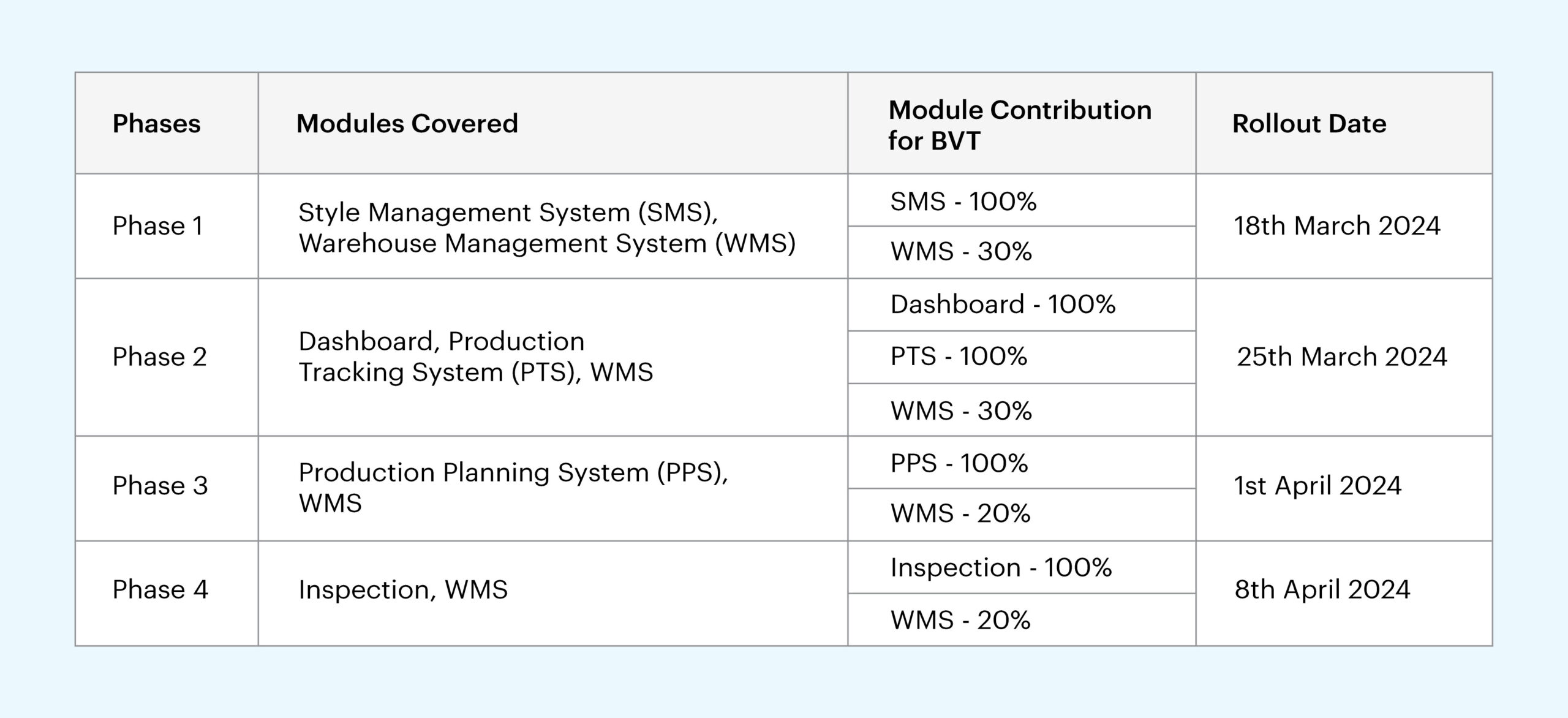
To ensure a smooth rollout and maximize critical module coverage, the automation was deployed in four phases. This phased approach enabled incremental testing, quick feedback, and early issue resolution, reducing disruption risks. Each phase focused on specific modules, prioritizing critical functions first. By the final phase, all essential modules had full BVT coverage.

Key highlights of each phase

  • Phase 1: Covered core modules in FLO System – achieved 100% BVT coverage, while WMS reached 30% due to complexity. This phase enabled early defect detection.
  • Phase 2: Expanded automation to Dashboard and PTS, both at 100% coverage. WMS coverage grew to 60%, improving stability and core functionality testing.
  • Phase 3: Fully automated PPS with 100% coverage. WMS reached 80%, boosting test efficiency and reducing manual effort.
  • Phase 4: Completed automation for Inspection, PPS, and WMS, each achieving 100% coverage. Enabled full automation of the build verification cycle.

Phased rollout results

  • Quick feedback: Faster feedback loops supported quicker development iterations.
  • Risk mitigation: Gradual rollout helped catch and fix automation issues early.
  • Continuous improvement: Insights from each phase refined scripts and test coverage, enhancing reliability and efficiency.

Regression automation

Regression testing ensures new changes don’t break existing features. Initially manual and error-prone, the process was automated to cover 67 test cases.

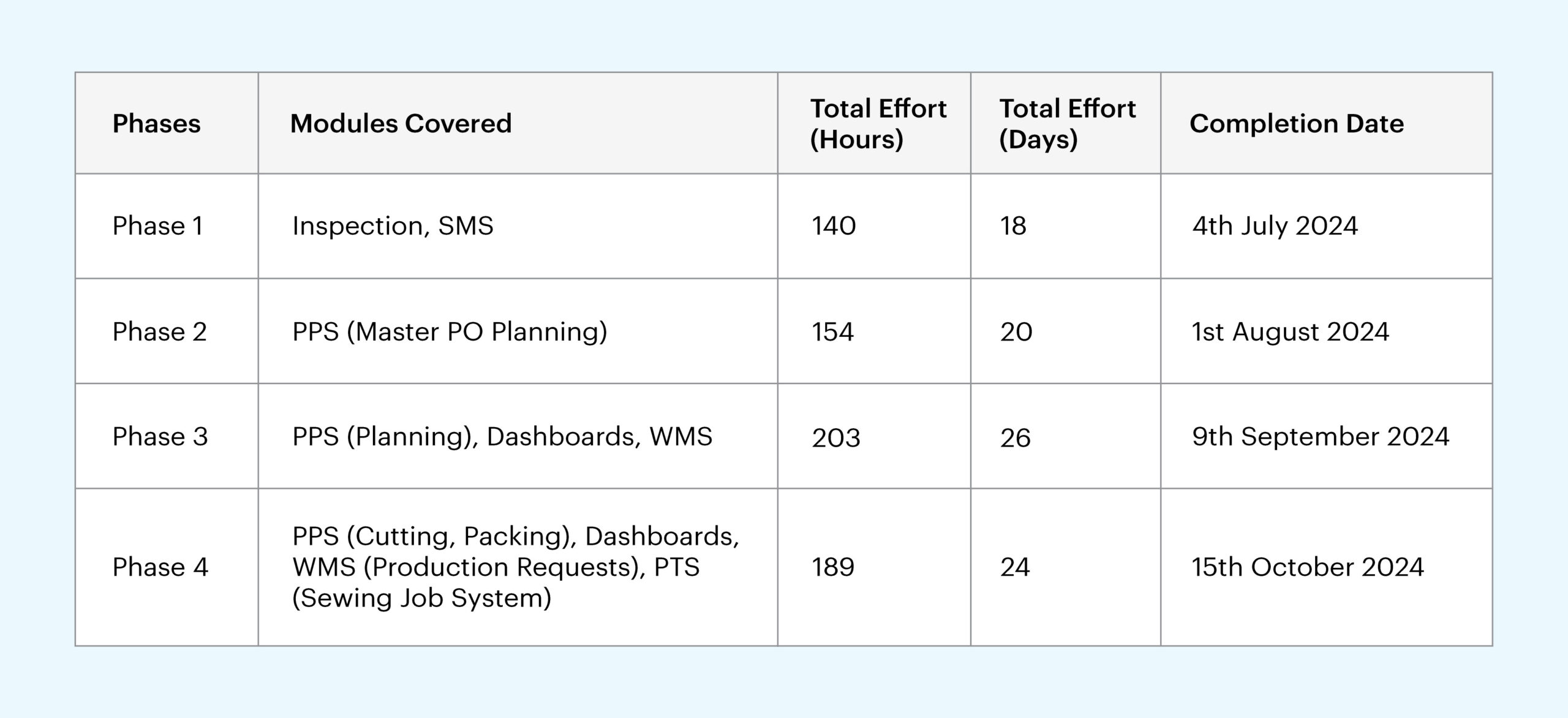
Regression automation was rolled out in four phases, each targeting specific modules. This phased approach allowed for gradual delivery of scripts, improved test coverage, and better use of resources. It also enabled ongoing script refinement and steady gains in execution speed and accuracy.

Key highlights of each phase

Phase 1 – Inspection, SMS

  • Modules: Inspection and SMS prioritized for core functionality checks.
  • Effort: 140 hours over 18 days.
  • Outcome: Inspection achieved 100% automation; SMS reached 30%. Laid the groundwork by automating simpler test cases.

Phase 2 – PPS (Master PO Planning)

  • Modules: PPS – Master PO Planning.
  • Effort: 154 hours over 20 days.
  • Outcome: 100% automation of this complex area, improving test accuracy and early issue detection.

Phase 3 – PPS (Planning), Dashboards, WMS

  • Modules: PPS (Planning), Dashboards, WMS.
  • Effort: 203 hours over 26 days.
  • Outcome: Full automation for PPS and Dashboards; WMS reached 60%. Expanded test scope and covered more intricate workflows.

Phase 4 – PPS (Cutting, Packing), WMS (Production Requests), PTS

  • Modules: Final critical modules including PPS (Cutting, Packing), WMS (Production Requests), and PTS.
  • Effort: 189 hours over 24 days.
  • Outcome: Achieved 100% automation across remaining modules, finalizing the regression suite and minimizing manual testing.

Results of the rollout

  • Full coverage: Complete automation of regression tests by end of Phase 4.
  • Efficient resourcing: Resources focused where needed most, with complexity increasing across phases.
  • Risk reduction: Early detection of issues reduced downstream risks.
  • Faster feedback: Each phase improved the speed and quality of developer feedback.
  • Improved quality: 100% automation ensured reliable, efficient testing with fewer errors and faster releases.

Benefits of automation

  1. Time savings
  • BVT execution: Cut from 6 hours (manual) to 30 minutes (automated) — saving 5.5 hours per build.
  • Regression testing: Reduced from 16–18 hours to 8–10 hours per cycle — saving up to 1.5 workdays each cycle.
  1. Off-hours test execution
  • Automation runs overnight via Azure DevOps Pipelines.
  • Test results are ready by the start of the workday, enabling quicker issue resolution and faster development cycles.
  1. Cost savings
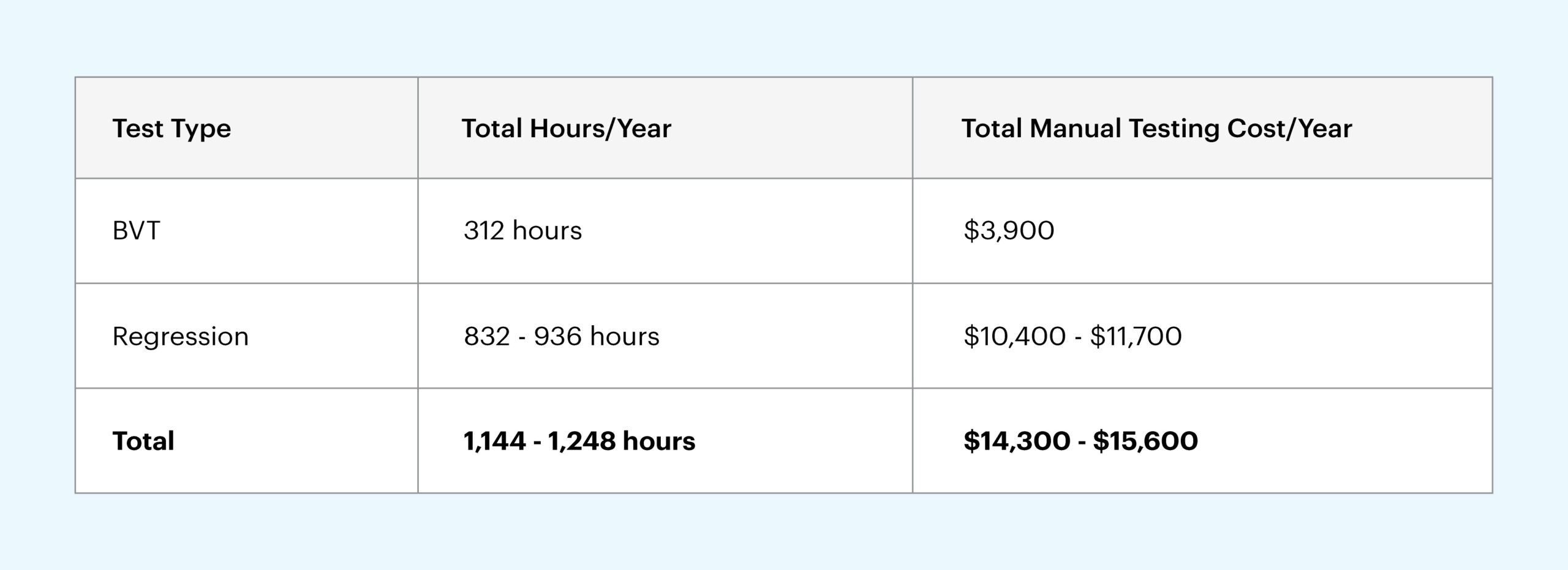
  • Manual cost benchmark: QA Engineer salary = $2,000/month → $12.50/hour.
  • Annual manual testing load:
    • BVT: 312 hours/year
    • Regression: 832–936 hours/year
  • Automation significantly cuts this effort, translating to substantial cost savings in recurring QA operations.

Recurring automation execution costs: The annual cost of executing the automation suite, using Azure Pipelines, is $504/year, which is a significantly lower expenditure compared to manual testing.

Cost savings calculation:

Annual Savings: $15,096 – $504 = $14592

The automation of BVT and Regression Testing results in annual savings of 90%, directly attributed to the use of automation.

…..

The automation of Build Verification Testing (BVT) and Regression Testing through the Fortest framework has led to impressive improvements in speed, cost-efficiency, and overall quality. BVT now completes in just 30 minutes, down from 6 hours manually, while regression testing is reduced to 8–10 hours instead of the usual 16–18. This has shaved off 1.5 days of testing per release. Additionally, the automation has freed up QA resources to focus on more valuable tasks like exploratory testing, ultimately enhancing product quality. With immediate feedback after every build, even outside of working hours, the development cycle is significantly faster. Overall, the implementation of Fortest has not only accelerated release times but also optimized resources and substantially reduced costs.

If you want to know how the Fortest framework can benefit your business, get in touch with our consultants.
FAQ

Terminology guide

SMS – Style Management System

WMS – Warehouse Management System

PTS – Production Tracking System

PPS – Production Planning System

FAQ

What is Fortest and how was it used in this project?
Fortest is Fortude’s automated regression testing tool. In this project, it automated both Build Verification Testing (BVT) and Regression Testing for a global apparel manufacturer. It replaced manual testing with faster, more accurate test cycles—boosting test coverage, cutting testing time, and supporting frequent releases with reliable feedback loops.
Why was automation necessary for this apparel manufacturer?
Manual testing consumed up to 24 hours per cycle and couldn’t keep pace with multiple weekly releases. It also limited coverage and delayed feedback. Automation through Fortest addressed these pain points, enabling quicker releases, improved test reliability, and better use of QA resources.
What benefits did the business gain from automation?
Automation reduced BVT execution time from 6 hours to 30 minutes and regression from 18 to 8–10 hours. It enabled overnight test runs, improved issue detection, and saved over $14,000 annually. QA teams could focus on strategic testing efforts, enhancing overall product quality.
How was the automation rolled out?
A phased rollout strategy was used. Both BVT and Regression automation were deployed module by module over four phases. This approach minimized disruption, ensured early wins, and allowed continuous script refinement—resulting in full coverage and stable, repeatable testing across all critical business modules.

“ Charlie’s agentic capabilities are specifically designed to address the volatility inherent in fashion and retail planning.”

– John Doe

Global supply chain leader in apparel
embarks on unified analytics

In production, AI agents optimize processes for waste reduction and improved sustainability.

CONTENTS

Introduction
Pre-automation challenges
BVT automation: Phased rollout
Regression automation
Benefits of automation
Terminology guide

Receive the latest
Fortude Newsletter
updates.

Share

Receive the latest
Fortude Newsletter
updates.

Share